How AI Is Reshaping Our Attention
The hidden cost of cognitive offloading and how to stay focused in a world of instant answers.

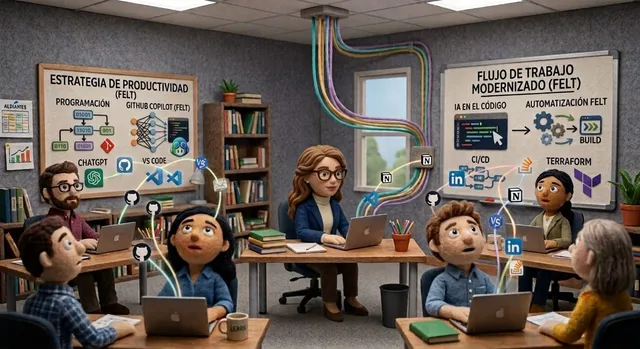
We live in a curious historical moment: for the first time, we have instant access to answers for virtually any technical question, yet many developers report that they think less and verify more. AI is quietly reshaping our attention patterns.
The Cognitive Offloading Phenomenon
In 2011, a team of psychologists led by Betsy Sparrow published a study in Science that went viral: "Google Effects on Memory"[1]. The main finding was that people **remembered less of the information itself and more where to find it** when they knew it was available online. Our brain, efficient as it is, outsources the retention of data it considers readily accessible.
This phenomenon, known as cognitive offloading[2], has intensified with generative AI. **Now we not only outsource information storage, but also the process of synthesis and reasoning.** We ask ChatGPT to summarize, compare, analyze, and then trust that summary without doing the mental work of reaching that conclusion ourselves.
Memory is not a passive repository of information, but an active process of reconstruction. When we outsource that process, we lose the opportunity to consolidate learning.
The Cost of Delegating Thought
Nicholas Carr, in The Shallows[3], warned that the internet was rewiring our neural circuits toward shallow reading and fragmented thinking. Fifteen years later, generative AI accelerates this transformation. If every technical question has an instant answer, **what incentive do we have to build deep mental models?**
A study by Ward et al. on the "Brain Drain" showed that the mere presence of a smartphone (even turned off) reduced available cognitive capacity[4]. Extrapolating: having an AI assistant always available in our editor, browser, and terminal could be exerting a similar effect, **draining attentional resources even when we are not actively using it**.
Quality vs. Speed
The paradox is evident: AI makes us faster at producing code, but potentially slower at understanding it. Instead of spending 30 minutes mentally designing a solution and 10 minutes coding it, **we spend 2 minutes writing a prompt and 20 minutes verifying, debugging, and adapting the result**.
Without AI
30 min mentally designing the solution
10 min coding it
40 min · with deep understanding
With AI
2 min writing a prompt
20 min verifying, debugging, and adapting
22 min · with shallow understanding
Production speed increases, but depth of understanding can decrease. And in the long run, deep understanding is what enables solid architectural decisions, anticipating problems, and building maintainable systems. I analyze the cost of that speed on learning in "Solving More, Learning Less", and its effect on cognitive load in "Cognitive Fatigue in the AI Era".
How to Protect Your Attention
- Read before you prompt: Before asking AI to solve a problem, spend 5 minutes thinking about how you would approach it. Even if you use AI afterward, that exercise keeps your problem-solving muscle active.
- Document what you learn: If AI gives you a novel solution, document it in your own words. The act of rewriting consolidates learning.
- Scheduled disconnection: Set aside times of day with no access to AI. Even 30 minutes in the morning or during coffee. Your brain needs space to think without external stimuli.
- Source diversity: Do not rely on a single AI. Cross-referencing responses from different models (or with traditional sources) keeps your critical judgment sharp.
Conclusion
AI is an extraordinary tool, but like any powerful tool, it changes how we work and think. Being aware of how it is reshaping our attention is not technophobia: it is professional maturity. **The goal is not to use less AI, but to use it better, without losing what makes us human: the ability to think deeply and critically.**
Sources
- Sparrow, B., Liu, J., & Wegner, D. M. (2011). "Google Effects on Memory: Cognitive Consequences of Having Information at Our Fingertips." Science, 333(6043), 776–778. DOI
- Risko, E. F., & Gilbert, S. J. (2016). "Cognitive Offloading." Trends in Cognitive Sciences, 20(9), 676–688. DOI
- Carr, N. (2010). The Shallows: What the Internet Is Doing to Our Brains. W. W. Norton. Link
- Ward, A. F., Duke, K., Gneezy, A., & Bos, M. W. (2017). "Brain Drain: The Mere Presence of One's Own Smartphone Reduces Available Cognitive Capacity." Journal of the Association for Consumer Research, 2(2), 140–154. DOI
AI Engineer at Unit4. Building intelligent software and writing about technology, productivity, and the impact of AI on the developer's daily life.