Solving More, Learning Less
How AI can speed up our work faster than it speeds up our learning.

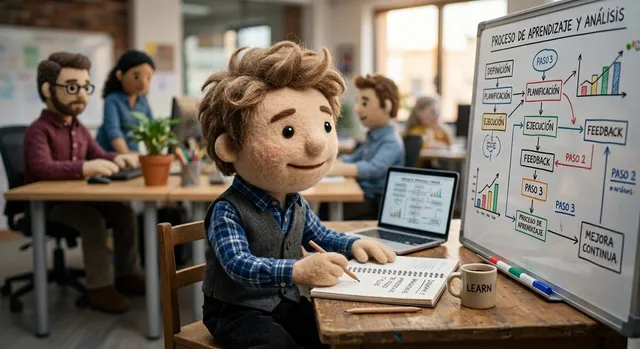
The Paradox of Outsourced Learning
While writing about how AI is changing productivity, an unexpected question came up: where did the learning go? When AI hands you the answer in minutes, something valuable disappears from the process: the path we used to walk to get there.
Because solving a problem without walking the path of understanding it is not the same as solving it and learning from it. And here is the argument of this post: AI helps us solve more problems than ever, but perhaps we've never learned so little from each of them.
In the debate about AI and work, most conversations revolve around money. "I'm generating more value, but I'm not capturing a proportional share." That's a legitimate concern. But there's a second one, quieter and, in the long run, more important: "I'm solving more problems, but maybe I'm learning less from them."
Experience Is Not Time
We say "she has twenty years of experience" as if experience were an automatic byproduct of time. It isn't. Experience is not time. Experience is the learning we get from time.
And learning doesn't come from solving problems: it comes from the friction we find while solving them. The hours of documentation, the failed attempts, mapping the limits of a system until you understand why it is the way it is. That path is what later lets you recognize patterns, anticipate problems, and design solutions others don't see.
The path from Senior to Staff, from Staff to Architect, and from Architect to Principal is built on that accumulated layer of understanding. It's not a résumé of solved problems; it's a mental map that grows with every problem solved by understanding how it was solved.
How AI Changes the Learning Process
Before, solving a problem followed a process that, without us planning it, was also a learning process:
Before AI
1. Problem
2. Research
3. Failed attempts
4. Deep understanding
5. Solution
With AI
1. Problem
2. Prompt
3. Answer
4. Solution
There's an important nuance: we're not using less cognitive capacity. In fact, we might think more than before: more context, more tools, more decisions. What changes isn't the amount of mental activity, but the kind. It's the same load I describe in "Cognitive Fatigue in the AI Era" and "How AI Is Reshaping Our Attention". Before, solving a problem forced you to learn: research, failed attempts, and understanding were unavoidable stages on the road to the solution. Knowledge was a byproduct of the problem-solving process. Now you can reach the solution without walking through all those stages. AI optimizes problem-solving, not necessarily the learning that used to come from it.
The difference isn't speed. The difference is that the steps we removed were exactly the steps that taught us. Failed attempts are what cement knowledge. Research is what builds the mental context. Deep understanding isn't a luxury: it's the part of the process that becomes you.
And here's the problem. Before, solving a problem was equivalent to learning: it was impossible to reach the solution without walking the stages that built knowledge. Now they are two things that can be separated. AI doesn't just outsource the work. It outsources the part of the work that made us grow.
The Risk to Career Progression
Let's put two specific people side by side.
Engineer A · 2025
NO AISpent years solving problems without AI: researched, failed, and understood.
Learned deeply from each of them.
Engineer B · 2026
WITH AIWorks with an AI that does the diagnosis.
Solved more, but learned less from each one.
If we compare their résumés, Engineer B looks more valuable. He has solved more problems than Engineer A, but he has learned less from them. And when the AI that gives him answers changes or disappears, that difference will become obvious.
Companies measure what's visible: speed, deliverables, closed tickets. Learning isn't visible. The risk is that we're accumulating output, not understanding.
The New Knowledge Professional
Imagine the job interview five years from now. The candidate has a spectacular track record: delivered a lot, been productive, used AI daily. But when you ask why she made a certain technical decision, or what limitations the system she built has, the answers get vague. She's worked on systems she only half understands, because she never had to understand them fully.
That is the new knowledge professional: productive in the present, but with a thinner layer of understanding than her predecessors. It's not that she's worse: she's faster. The problem is that professional growth stops being the natural consequence of years of work and becomes something you have to actively pursue.
Training Our Replacements
There's something uncomfortable in all of this. Every time we use AI to solve a problem, three actors are at play:
The worker
Solves more problems, faster.
The company
Produces more with the same headcount.
The AI provider
Collects revenue and, above all, the usage data that improves the model.
Notice where the problem-solving capacity is increasingly concentrated. The company captures it as productivity, the AI provider as better models, and the worker gets the solution, but not always the whole process that used to generate learning.
There's an irony that's hard to ignore. While more and more professionals delegate part of their learning process to the models, the AI industry desperately seeks more human knowledge to keep training them. Companies like Anthropic have bought, scanned, and destroyed millions of physical books to use them as training data, as 404 Media reported. They're not looking for AI-generated text: they're looking for books written before the LLM boom, because they consider original human knowledge the most valuable and least contaminated fuel. If human knowledge remains AI's most precious asset, what happens if we stop producing people who walk the processes that generate that knowledge?
A bricklayer with an excavator doesn't lose the trade: the excavator is a tool he controls and understands. A pilot with an autopilot doesn't either: they spend thousands of hours in simulators precisely because the autopilot reduces manual flying time. The knowledge worker, by contrast, uses a tool that makes decisions for him, and there's no simulator compensating for what he stops practicing.
AI can make us more productive in the present while reducing part of the learning we need to grow professionally in the future. The question isn't whether we should use AI. The question is whether we're using the speed it gives us to learn more or simply to produce more.
AI Engineer at Unit4. Building intelligent software and writing about technology, productivity, and the impact of AI on the developer's daily life.